
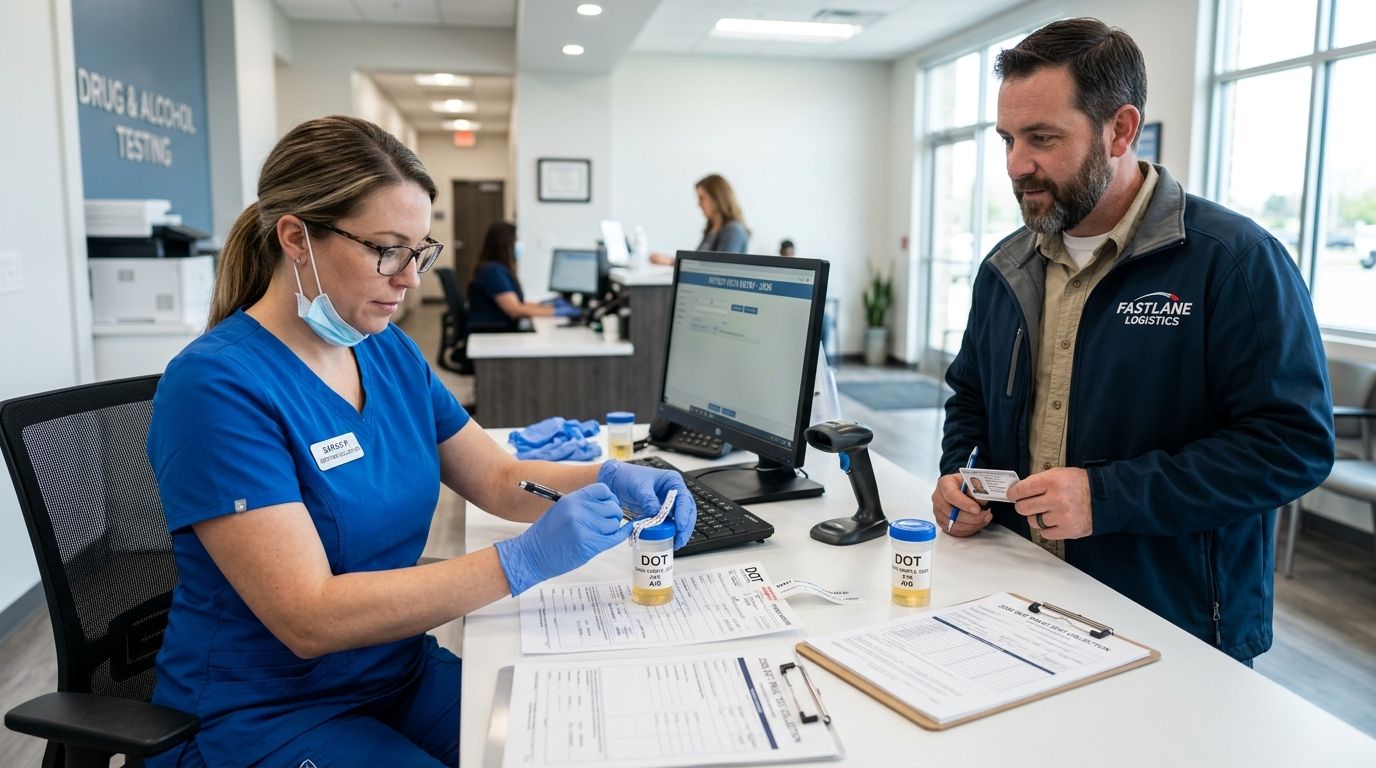
A DOT drug test isn't one flat fee — it's a stack of separate charges: specimen collection, lab analysis, Medical Review Officer (MRO) review, and often a mobile dispatch or after-hours charge layered on top. Most employers underestimate the total because they price only the lab test and forget the collection and MRO fees that show up on every single result, positive or negative.
- DOT drug test pricing in 2026 is built from four line items: collection, lab fee, MRO review, and often a mobile service charge.
- Mobile 24/7 collection adds a service fee but removes downtime for drivers waiting at a fixed clinic.
- The standard DOT panel tests five drug classes under 49 CFR Part 40 — non-DOT panels can cost differently depending on scope.
- Random, post-accident, and reasonable suspicion tests can carry different fees than routine pre-employment screening.
- [Care Route Logistics](https://careroutelogisticsllc.com/) collects specimens on-site in Amarillo and the Texas Panhandle for carriers whose drivers can't leave the yard.
Why this matters
Carriers, dispatchers, and TPAs budgeting for compliance testing get burned when they quote a single number off a lab's website and skip the collection and MRO charges. A driver who fails to complete a required DOT drug test — pre-employment, random, post-accident, reasonable suspicion, or return-to-duty — can't legally operate a commercial motor vehicle under 49 CFR Part 40, so the real cost of skipping a line item isn't savings, it's a parked truck.
Mobile collection changes the math further. A driver pulled for random testing at a terminal 40 miles from the nearest fixed clinic either sits idle for hours or a collector comes to the truck. Both options have a cost — one in dollars, one in downtime — and 2026 fuel and labor rates make the downtime side more expensive than most dispatchers assume.
How much does a DOT drug test cost?
The honest answer: it depends on which of these components apply to your situation.
| Cost component | What it covers | When it applies |
|---|---|---|
| Collection fee | Collector time, supplies, chain-of-custody paperwork | Every test, every time |
| Lab analysis fee | Screening plus confirmation testing at a certified lab | Every test |
| MRO review fee | Physician review of results before they're reported | Every test, pass or fail |
| Mobile/onsite fee | Collector travel to a yard, terminal, or roadside site | Only for mobile or after-hours collection |
| Random pool/consortium fee | Enrollment in a random testing pool | Ongoing, not per-test |
Each line item is billed separately by the collection agency, the lab, and the MRO in most arrangements — some agencies bundle collection and MRO into one quote, others don't. Ask for an itemized quote before you compare two providers, because a lower headline number sometimes hides a courier fee added after the fact.
Why DOT drug test cost varies
Five factors push the total up or down:
- Panel type — the standard DOT panel tests five drug classes under 49 CFR Part 40; expanded or non-DOT panels test more substances and can carry a different fee structure.
- Test reason — pre-employment, random, post-accident, reasonable suspicion, return-to-duty, and follow-up tests aren't always priced the same way by every agency.
- Collection location — a fixed clinic visit is typically the cheapest option on paper; mobile collection at a yard, terminal, or roadside site adds a dispatch charge but eliminates driver downtime.
- Time of day — after-hours, weekend, or emergency response collection (common for post-accident testing) usually carries a premium over standard business-hours scheduling.
- Contract volume — carriers and TPAs with standing random-testing programs typically negotiate lower per-test rates than a one-off collection request.
- MRO complexity — a straightforward negative result reviews quickly; a dilute, invalid, or positive result triggers additional MRO steps that can affect turnaround and cost.
The takeaway: get an itemized quote that separates collection, lab, and MRO before comparing providers — a single bundled number tells you nothing about where your money is actually going.
Care Route Logistics LLC runs 24/7 mobile DOT and non-DOT specimen collection across Amarillo and the Texas Panhandle, which matters for carriers whose drivers are passing through the region rather than based there — dispatch a collector to the terminal instead of rerouting a driver to a clinic.
Need a mobile collection scheduled?
24/7 DOT and non-DOT specimen collection across Amarillo and the Texas Panhandle.
Is DOT drug test cost different from non-DOT testing cost?
Yes — non-DOT testing isn't bound by 49 CFR Part 40, so employers can choose broader or narrower panels, different collection procedures, and different MRO requirements, all of which change the fee structure compared to a federally mandated DOT test. A non-DOT test for a company drug policy might skip MRO review entirely, which removes a line item but also removes a layer of legal defensibility if a result is challenged.
Who pays for a DOT drug test?
Under FMCSA rules, the employer is responsible for the cost of DOT-required testing, not the driver — pre-employment, random, post-accident, reasonable suspicion, return-to-duty, and follow-up tests are all employer-funded. TPAs and consortiums often bill the employer directly per test or per contract, which is why carriers with larger driver pools typically negotiate volume pricing instead of paying one-off rates.
Does a positive DOT drug test cost more than a negative one?
A positive or dilute result triggers additional MRO review steps — verification calls, possible split-specimen retesting — that can add time and cost beyond the standard collection and lab fee. Return-to-duty and follow-up testing programs required after a positive result also add ongoing costs that a one-time negative result never generates.
FAQ
How much does a DOT drug test cost in 2026?
The total is built from collection, lab analysis, and MRO review fees rather than one flat number, and mobile or after-hours collection adds a service charge on top. Get an itemized quote from your testing provider to see how each line item applies to your situation.
What's included in a DOT drug test fee?
A standard fee covers specimen collection, chain-of-custody paperwork, lab screening and confirmation testing, and MRO physician review of the result. Mobile collection at a yard or terminal typically adds a separate dispatch fee.
Is mobile DOT drug testing more expensive than a clinic visit?
Mobile collection usually carries a dispatch fee that a fixed clinic visit doesn't, but it eliminates the driver downtime and lost hours-of-service that come with sending a driver offsite. For carriers with drivers already at a terminal, the dispatch fee often costs less than the lost driving time.
Who is legally required to pay for a DOT drug test?
The employer pays for DOT-required testing under FMCSA rules, covering pre-employment, random, post-accident, reasonable suspicion, return-to-duty, and follow-up tests. The driver is not billed for federally mandated testing.
Does DOT drug test cost include the MRO review?
Most collection agencies bundle MRO review into the quoted fee, but some bill it separately, so ask before comparing providers. Every DOT result, positive or negative, requires MRO review under 49 CFR Part 40.
How is non-DOT drug testing priced differently?
Non-DOT testing isn't governed by 49 CFR Part 40, so employers can choose different panels and skip MRO review, which changes the fee structure compared to a federally mandated test. Coverage and legal defensibility can differ as a result.
Why did my DOT drug test cost more than expected?
Unexpected charges usually come from after-hours collection, mobile dispatch fees, or additional MRO steps triggered by a dilute or non-negative result. Ask for an itemized breakdown before scheduling to avoid surprise line items.
One last thing
The line item most carriers forget to ask about isn't the lab fee — it's the MRO review, because every single DOT test requires it, pass or fail, and some agencies quote a lab price that doesn't include it. Ask for that number specifically before you compare two testing providers on price alone in 2026, or you'll compare an incomplete quote against a complete one.